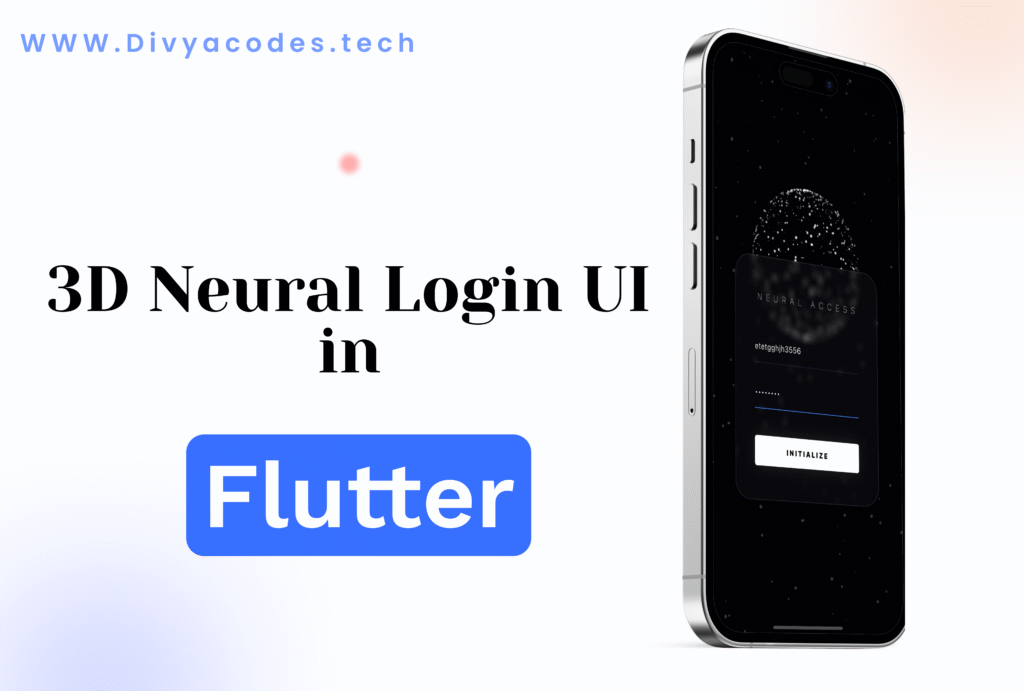

When designing interfaces for AI platforms, fintech dashboards, or futuristic applications, traditional UI patterns often feel outdated. I wanted to experiment with something deeper — something that felt alive.
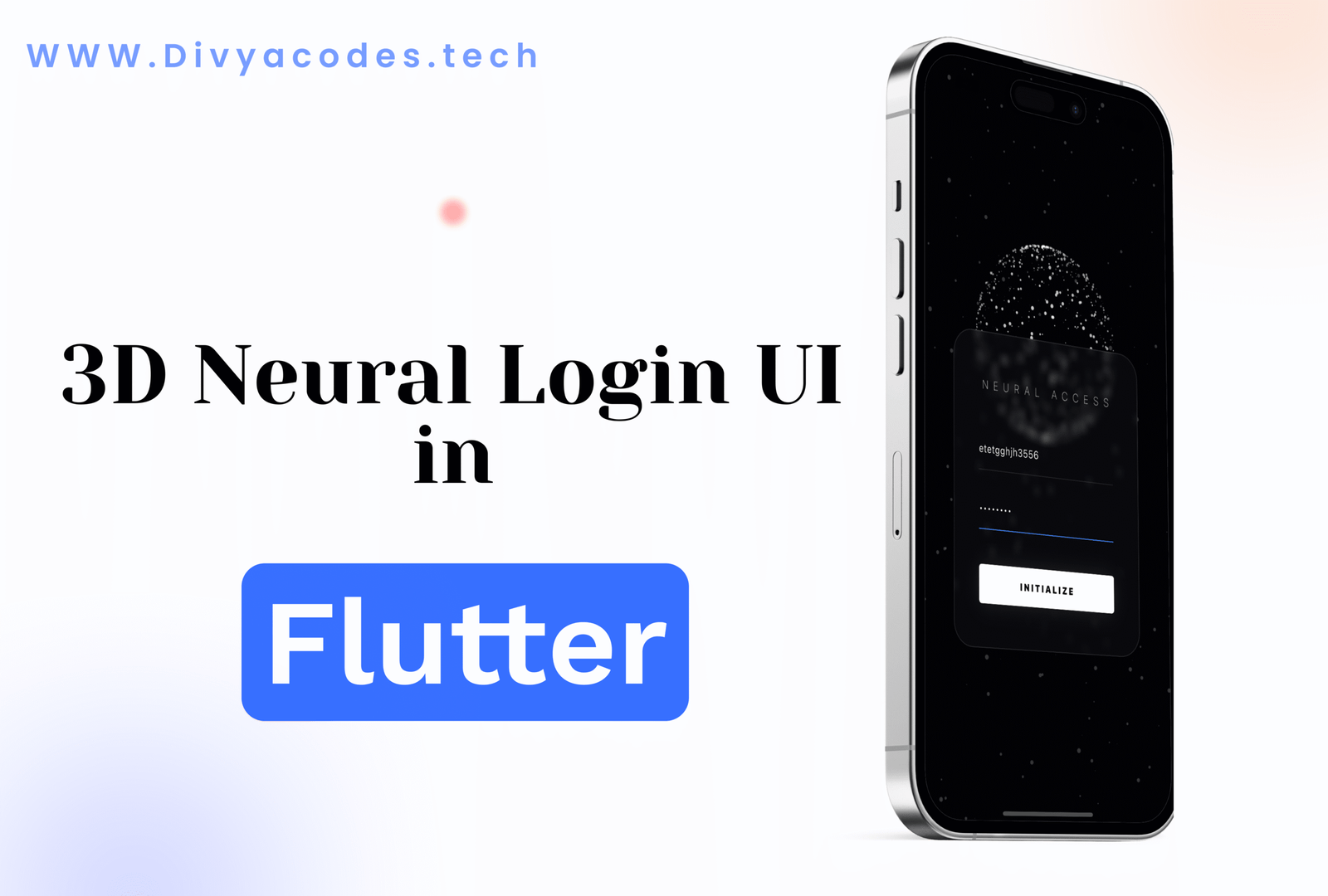
So I built a 3D rotating neural sphere with a galaxy background and a glassmorphism login interface using pure Flutter.
No third-party 3D engine.
No external animation packages.
Just clean Flutter + CustomPainter.
Animated Galaxy Background
To create depth, I added a moving starfield in the background.
Using CustomPainter, small stars are drawn on the canvas and animated vertically. The slow movement creates a calm, space-like atmosphere without distracting the user.
This keeps performance smooth while making the UI feel dynamic.
3D Rotating Particle Sphere
The main highlight is a rotating sphere made of tiny particles.
Each particle is placed using mathematical angles and converted into 2D positions. By adjusting opacity and size based on depth, the sphere looks 3D — even though Flutter is a 2D framework.
The sphere:
Can also be rotated manually using gestures
Rotates automatically
This adds interaction and makes the interface feel premium.
Glassmorphism Login Panel
On top of everything, I placed a blurred glass-style login card.
Using:
- Backdrop blur
- Soft white borders
- Minimal typography
The form feels like a floating “neural access terminal.”
Full Source Code:
import 'dart:math' as math;
import 'dart:ui';

import 'package:flutter/material.dart';

void main() => runApp(
  const MaterialApp(debugShowCheckedModeBanner: false, home: LucrativeSphere()),
);

class LucrativeSphere extends StatefulWidget {
  const LucrativeSphere({super.key});

  @override
  State<LucrativeSphere> createState() => _LucrativeSphereState();
}

class _LucrativeSphereState extends State<LucrativeSphere>
    with TickerProviderStateMixin {
  late AnimationController _autoRotationController;
  final List<Particle> _particles = [];
  final List<GalaxyStar> _galaxyStars = [];

  double _manualRotationX = 0;
  double _manualRotationY = 0;

  @override
  void initState() {
    super.initState();
    final random = math.Random();

    for (int i = 0; i < 1000; i++) {
      _particles.add(
        Particle(
          theta: random.nextDouble() * 2 * math.pi,
          phi: random.nextDouble() * math.pi,
          size: random.nextDouble() * 1.5 + 0.2,
        ),
      );
    }

    for (int i = 0; i < 200; i++) {
      _galaxyStars.add(
        GalaxyStar(
          x: random.nextDouble(),
          y: random.nextDouble(),
          size: random.nextDouble() * 3,
          velocity: random.nextDouble() * 0.02 + 0.005,
        ),
      );
    }

    _autoRotationController = AnimationController(
      vsync: this,
      duration: const Duration(seconds: 50),
    )..repeat();
  }

  @override
  void dispose() {
    _autoRotationController.dispose();
    super.dispose();
  }

  @override
  Widget build(BuildContext context) {
    return Scaffold(
      backgroundColor: const Color(0xFF010105),
      body: GestureDetector(
        onPanUpdate: (details) {
          setState(() {
            _manualRotationY += details.delta.dx * 0.008;
            _manualRotationX -= details.delta.dy * 0.008;
          });
        },
        child: Stack(
          alignment: Alignment.center,
          children: [
            // 1. Background Galaxy
            AnimatedBuilder(
              animation: _autoRotationController,
              builder:
                  (context, child) => CustomPaint(
                    size: MediaQuery.of(context).size,
                    painter: GalaxyPainter(
                      _galaxyStars,
                      _autoRotationController.value,
                    ),
                  ),
            ),

            // 2. The 3D Sphere
            Positioned(
              top: 40,

              child: AnimatedBuilder(
                animation: _autoRotationController,
                builder:
                    (context, child) => CustomPaint(
                      size: MediaQuery.of(context).size / 1.6,
                      painter: SpherePainter(
                        particles: _particles,
                        rotationY:
                            (_autoRotationController.value * 2 * math.pi) +
                            _manualRotationY,
                        rotationX: _manualRotationX,
                      ),
                    ),
              ),
            ),

            // 3. The Lucrative Glass Form
            Positioned(bottom: 200, child: _buildGlassForm()),
          ],
        ),
      ),
    );
  }

  Widget _buildGlassForm() {
    return ClipRRect(
      borderRadius: BorderRadius.circular(30),
      child: BackdropFilter(
        // This hides/diffuses the particles behind the form
        filter: ImageFilter.blur(sigmaX: 5, sigmaY: 5),
        child: Container(
          width: 300,
          padding: const EdgeInsets.symmetric(horizontal: 40, vertical: 50),
          decoration: BoxDecoration(
            color: Colors.white.withOpacity(0.03),
            borderRadius: BorderRadius.circular(30),
            border: Border.all(color: Colors.white.withOpacity(0.12), width: 1),
          ),
          child: Column(
            mainAxisSize: MainAxisSize.min,
            children: [
              const Text(
                "NEURAL ACCESS",
                style: TextStyle(
                  color: Colors.white,
                  letterSpacing: 8,
                  fontSize: 14,
                  fontWeight: FontWeight.w200,
                ),
              ),
              const SizedBox(height: 40),
              _buildField("IDENTITY_TOKEN"),
              const SizedBox(height: 20),
              _buildField("SECURITY_KEY", isPassword: true),
              const SizedBox(height: 40),
              _buildButton(),
            ],
          ),
        ),
      ),
    );
  }

  Widget _buildField(String hint, {bool isPassword = false}) {
    return TextField(
      obscureText: isPassword,
      style: const TextStyle(color: Colors.white, fontSize: 13),
      decoration: InputDecoration(
        hintText: hint,
        hintStyle: TextStyle(
          color: Colors.white.withOpacity(0.2),
          letterSpacing: 2,
        ),
        enabledBorder: UnderlineInputBorder(
          borderSide: BorderSide(color: Colors.white.withOpacity(0.1)),
        ),
        focusedBorder: const UnderlineInputBorder(
          borderSide: BorderSide(color: Colors.blueAccent),
        ),
      ),
    );
  }

  Widget _buildButton() {
    return Container(
      width: double.infinity,
      height: 45,
      decoration: BoxDecoration(
        color: Colors.white,
        borderRadius: BorderRadius.circular(4),
        boxShadow: [
          BoxShadow(color: Colors.white.withOpacity(0.1), blurRadius: 20),
        ],
      ),
      child: TextButton(
        onPressed: () {},
        child: const Text(
          "INITIALIZE",
          style: TextStyle(
            color: Colors.black,
            fontWeight: FontWeight.w900,
            letterSpacing: 2,
            fontSize: 12,
          ),
        ),
      ),
    );
  }
}

// --- Logic Classes ---

class Particle {
  final double theta, phi, size;
  Particle({required this.theta, required this.phi, required this.size});
}

class GalaxyStar {
  final double x, y, size, velocity;
  GalaxyStar({
    required this.x,
    required this.y,
    required this.size,
    required this.velocity,
  });
}

class SpherePainter extends CustomPainter {
  final List<Particle> particles;
  final double rotationY, rotationX;
  SpherePainter({
    required this.particles,
    required this.rotationY,
    required this.rotationX,
  });

  @override
  void paint(Canvas canvas, Size size) {
    final center = Offset(size.width / 2, size.height / 2);
    final radius = size.width * 0.45;
    final paint = Paint();

    for (var p in particles) {
      double rT = p.theta + rotationY;
      double rP = p.phi + rotationX;
      double x = radius * math.sin(rP) * math.cos(rT);
      double y = radius * math.cos(rP);
      double z = radius * math.sin(rP) * math.sin(rT);

      double zDepth = (z + radius) / (2 * radius);
      paint.color = Colors.white.withOpacity(0.1 + (zDepth * 0.7));
      canvas.drawCircle(
        Offset(center.dx + x, center.dy + y),
        p.size * (0.5 + zDepth),
        paint,
      );
    }
  }

  @override
  bool shouldRepaint(covariant CustomPainter oldDelegate) => true;
}

class GalaxyPainter extends CustomPainter {
  final List<GalaxyStar> stars;
  final double progress;
  GalaxyPainter(this.stars, this.progress);

  @override
  void paint(Canvas canvas, Size size) {
    final paint = Paint()..color = Colors.white.withOpacity(0.2);
    for (var s in stars) {
      double movingY = (s.y + (progress * s.velocity * 5)) % 1.0;
      canvas.drawCircle(
        Offset(s.x * size.width, movingY * size.height),
        s.size,
        paint,
      );
    }
  }

  @override
  bool shouldRepaint(covariant CustomPainter oldDelegate) => true;
}
Flutter is more powerful than we think.
With just math and CustomPainter, we can build immersive 3D-like interfaces — without any external engine.
Sometimes, great UI is not about more packages.
It’s about creativity.